
A 200 amp panel upgrade with solar may still be worth considering if your electrical service, panel condition, or planned loads call for a change. Solar production does not automatically expand your service capacity or repair aging equipment. Call Expert Electric Group at (747) 999-6090 to discuss your home’s setup and the questions to ask.
Call (747) 999-6090 to discuss your panel and solar system
Does solar mean a home no longer needs a panel upgrade?
Short answer: No. Solar generation and the ability of a home’s electrical service to support its loads are separate considerations. The existing service rating, panel condition, solar interconnection, and planned additions all matter. The presence of rooftop panels by itself is not enough to decide whether an upgrade is needed.
A grid-connected solar array produces electricity under suitable conditions. That production may offset some of a home’s energy use, but it does not necessarily change the rating of the utility service or create additional breaker spaces. The home may still draw electricity from the utility when solar output is low or when demand is higher than production. A panel assessment needs to consider the home’s electrical equipment and intended use, not just the solar array’s output.
For broad background on energy topics, the U.S. Department of Energy provides public energy information at energy.gov. That general information is not a substitute for a project-specific electrical evaluation. If you are also weighing a charger, see this guide to 200 amp service and EV charging and the company’s electrical panel upgrade service.
What should an electrician evaluate before recommending 200 amp service?
Short answer: An electrician should review the service equipment and its ratings, panel condition and available spaces, the home’s present and planned electrical loads, and the solar connection. This assessment helps distinguish a need for repairs from a panel replacement or a service-capacity change.
- Service and panel ratings: Identify the equipment ratings rather than infer capacity from the size of the enclosure or the number of breakers. A panel replacement and a service upgrade are related but not identical scopes of work.
- Panel condition: Look for visible corrosion, heat effects, damage, loose or unstable equipment, or recurring breaker problems. A homeowner should not remove a panel cover to inspect internal parts.
- Current loads: Record major electrical uses such as heating and cooling equipment, ranges, dryers, water heating, and existing charging or backup equipment. The electrician will determine the appropriate calculation method for the project.
- Planned loads: Include likely additions, not just equipment already installed. An EV charger, electric appliance conversion, workshop, addition, or other renovation may change the assessment.
- Solar and related equipment: Provide information about the inverter and the way the solar system connects to the home’s electrical equipment. Include batteries or backup equipment if installed or being considered.
- Service route and site constraints: Meter location, service conductors, utility connection, panel access, and the layout of the home can affect the work. A panel project may involve more than changing the enclosure.
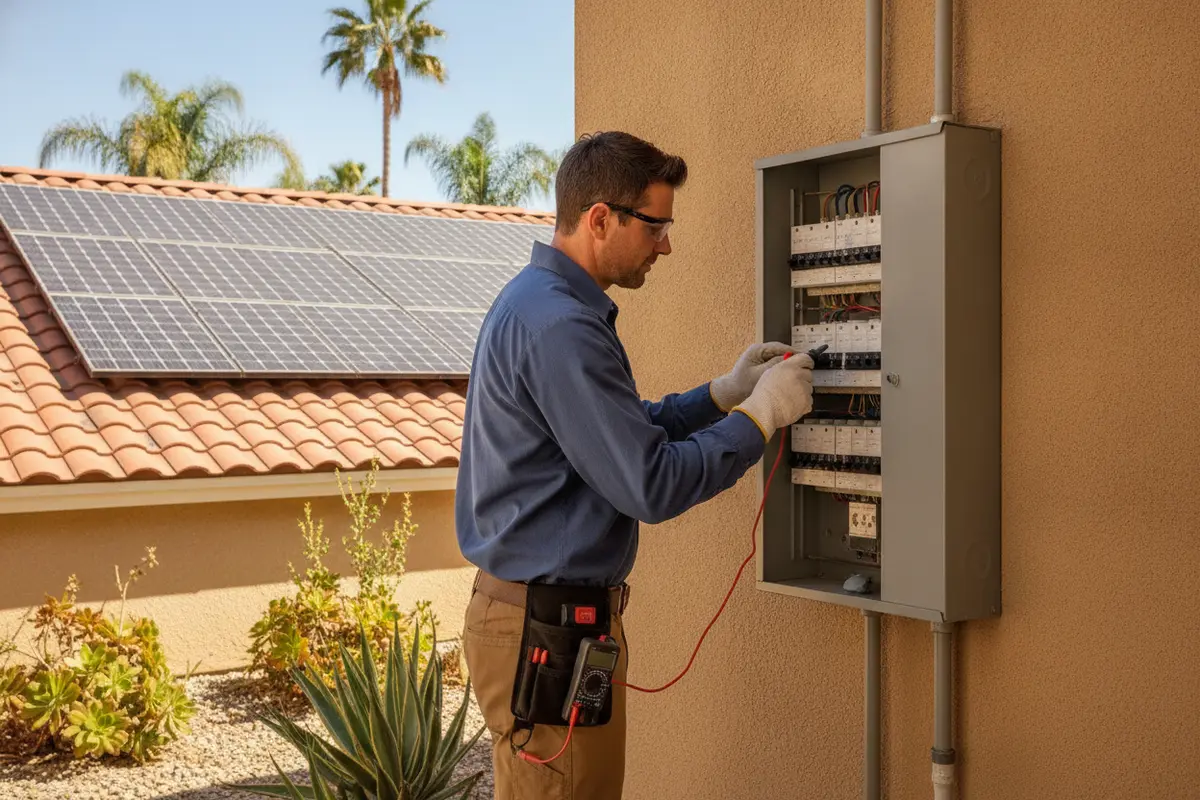
Bring photos of the panel exterior and its existing labels, but do not open the cover. If you hear a buzz, notice heat, see damage, or experience repeated trips, describe the details to a professional. For context on unusual sounds, read what electrical panel buzzing can mean. If lights are flickering, this related guide explains when flickering lights may need attention.
Which household changes can make a capacity review useful?
Short answer: A capacity review can be useful before adding substantial electrical loads, changing fuel-burning appliances to electric, or renovating. It can also help when equipment is damaged or the existing setup does not suit the solar system. The findings—not solar ownership alone—should guide the decision.
Consider a homeowner planning to add an EV charger and replace a gas range with an electric model. The solar array may offset some electricity use over time, but that fact does not establish whether the current service can support the planned equipment. The electrician needs details about the charger, existing appliances, solar interconnection, and other loads before discussing options. Depending on the assessment, the answer could be a service upgrade, a different equipment arrangement, or another solution.
A second example is a home with a panel in good condition and no major new loads, but limited room for circuits. The homeowner may need an appropriate way to accommodate circuits, but limited breaker spaces alone do not prove that 200 amp service is required. The contractor should explain which constraint the proposed work solves and whether other equipment must change. Review the company’s electrical services for examples of the kinds of residential work that may be part of a project.
A battery, generator, or major home renovation can add coordination needs. The solar equipment, backup equipment, service, and panel must be considered as a connected installation rather than independent purchases. For related planning, explore Level 2 EV charger installation, whole-home generator requirements, and whole-home rewiring.
What are the possible paths, and what does each address?
Short answer: The appropriate path may be a repair, a panel replacement, a service upgrade, or a coordinated design for several pieces of equipment. Ask the electrician to connect each recommendation to a finding from the assessment.
| Possible path | May be considered when | What to clarify |
|---|---|---|
| Repair or circuit adjustment | The equipment is otherwise suitable and the concern is limited | Which issue it resolves and whether the planned loads remain supported |
| Panel replacement | The panel is damaged, outdated, or not suitable for the project | Whether service capacity changes, and how solar interconnection is handled |
| 200 amp service and panel upgrade | The evaluation supports a service change or planned work needs additional capacity | Utility coordination, meter equipment, conductors, permits, solar review, and inspection |
| Other system configuration | Site conditions or project requirements call for a different arrangement | Load analysis, equipment compatibility, approvals, and the limits of the proposed design |
There is no universal cost or schedule for these paths. The scope depends on the existing installation, materials, utility requirements, local review, and whether solar equipment needs modification. Ask for a written explanation of what is included, what is excluded, and which approvals or other providers are involved. For more project background, see how a 200 amp panel upgrade is approached, the company’s overview of factors affecting a 200 amp upgrade in California, and its guide to main breaker panel replacement.
Call (747) 999-6090 to review your panel upgrade options
What permits and coordination may be involved?
Short answer: Panel or service work and changes to solar equipment may involve permits, inspections, and coordination with the utility or solar provider. The exact requirements depend on the work, the equipment, the utility, and the local authority having jurisdiction.
Before work begins, ask who will confirm the permit scope and whether utility service work is needed. If the solar system must be disconnected, moved, or changed, clarify who will arrange that work and how reconnection, approvals, and inspection will be handled. An existing solar approval should not be assumed to cover a different panel configuration or new electrical work.
Make sure the proposed scope names the equipment being changed and any work that remains with another provider. Ask whether the solar system will be unavailable during any part of the project and who will explain the planned sequence. These questions help avoid a gap between panel work and solar-system work. For a related example of project-specific approvals, see the company’s guide to permits for an EV charger.
How can you prepare for a useful assessment?
Short answer: Gather solar documents and panel photos, make a list of current and planned loads, and describe any symptoms. A clear project brief helps the electrician focus the site assessment and explain the choices.
- Photograph, do not open: Take clear photos of the panel exterior, labels, and nearby meter equipment if accessible. Leave covers and internal components untouched.
- Collect solar details: Locate available paperwork or equipment labels for the inverter and any battery or backup system. Note the installer or provider if you know it.
- List major loads: Include heating and cooling, cooking, laundry, water heating, EV charging, and other significant equipment. Note which appliances are planned rather than already installed.
- Explain the project: Describe whether you are adding a charger, converting appliances, renovating, or seeking more circuit capacity. Mention the desired timing if a project is already scheduled.
- Report symptoms: Write down when breakers trip, lights flicker, or sounds or smells occur. Do not repeatedly reset a breaker that trips or try to diagnose internal wiring yourself.
- Ask for the scope: Confirm whether the proposal covers only the panel or also the service, meter, conductors, solar connection, utility coordination, permits, and inspection.
For a homeowner comparing contractors, ask what findings support the recommendation and what alternatives were considered. Ask how the project will protect and account for existing solar equipment, what information the utility or permitting office needs, and who will be responsible for each coordination step. You can check the company’s Southern California service areas and learn more about Expert Electric Group before requesting a project discussion.
How do you compare an electrician’s recommendations?
Short answer: Compare the reason for the work, the specific equipment included, and the coordination plan—not just the proposed service rating. A clear recommendation should connect the observed conditions and planned loads to a defined scope.
Start by asking the electrician to explain the assessment in practical terms. Which part of the existing installation is limiting the project: the service capacity, the panel’s condition, the available circuit spaces, or a compatibility issue with the solar equipment? These are different issues, and they may not call for the same work. Ask what is known from the inspection and what still needs confirmation from the utility, permitting office, or solar provider.
Next, compare the boundaries of each proposal. One proposal may cover a panel replacement, while another may include service conductors, meter equipment, permit fees, or coordination for the solar connection. Confirm who is responsible for disconnecting and reconnecting solar equipment if needed, how inspections fit the schedule, and whether any work is assigned to another provider. Do not assume two proposals describe the same project just because both mention a 200 amp upgrade.
Finally, ask what the chosen work will not solve. A service upgrade does not automatically resolve every wiring concern or guarantee that all future equipment will fit without further review. Understanding those limits makes it easier to decide whether to proceed now, revise the project, or gather more information first.
Call (747) 999-6090 to talk through your assessment and next steps
Frequently asked questions
Can solar panels replace a 200 amp service?
No. Solar panels generate electricity, but they do not themselves replace the utility service or establish the rating and condition of the home’s panel. Have the service and loads assessed separately.
Does every home with solar need a 200 amp panel?
No. The right solution depends on the existing service, panel condition, calculated loads, solar connection, and plans for future equipment. Some homes may not need a change; others may need repairs, a replacement, or a service upgrade.
Will an EV charger automatically require a 200 amp upgrade?
Not in every case. The charger’s requirements, other loads, existing equipment, and applicable assessment all matter. An electrician can compare the planned charger with the home’s electrical setup before recommending a path.
Does a panel upgrade always require solar-system changes?
No, but the solar connection needs to be included in the project review. Whether the system must be altered depends on the proposed panel arrangement and the existing equipment. Confirm the coordination and approval plan before work begins.
What should I do if the panel is buzzing, hot, or damaged?
Keep clear and arrange professional attention. Do not open the panel or attempt repairs. If you see smoke, fire, or another immediate hazard, leave the area and contact emergency services.
Call (747) 999-6090 to discuss your home’s panel and solar setup
A project-specific assessment can show whether your solar-equipped home needs a 200 amp upgrade, a different panel solution, or no change at all.
