
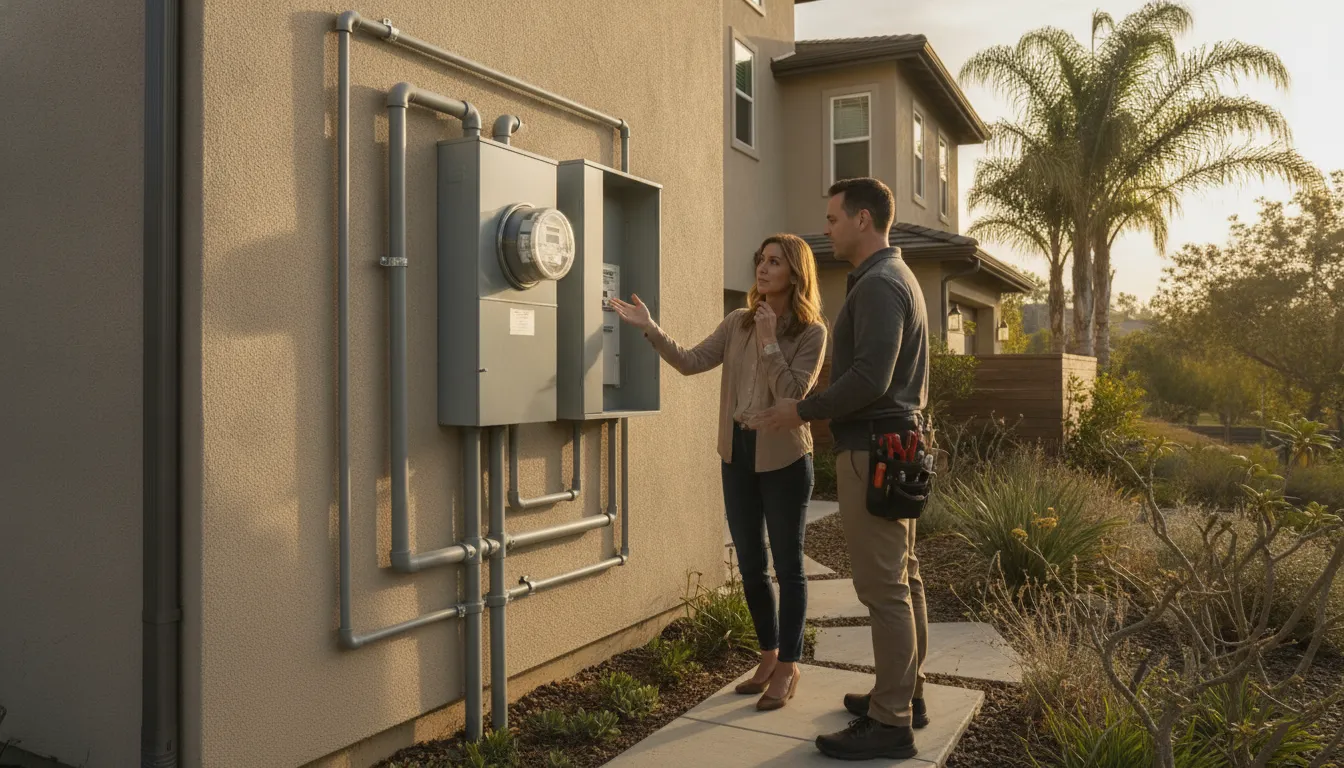
Adding an EV charger, heat-pump equipment, or other major electrical loads can expose limits in an older home’s service. A larger meter is not automatically the right answer, and the safest plan starts with understanding the home’s actual demand.
A 300 amp meter base may be appropriate when a qualified load calculation shows that the home’s present and planned electrical demand exceeds a smaller service capacity. The decision also depends on the panel, conductors, disconnects, local permits, and approval from the serving utility.
Before planning work, homeowners in Los Angeles, Ventura, Orange, Riverside, or San Bernardino County should have the existing system assessed and future loads considered. Call Expert Electric Group at (747) 999-6090 to discuss service-capacity planning. Understanding what the meter base does is the first step toward choosing an upgrade that fits the home rather than simply selecting the largest available rating.
What Is a 300 Amp Meter Base, and What Does It Do?
A 300 amp meter base is the enclosure where the electric utility’s meter is installed and connected to a home’s service entrance conductors. It provides the physical connection point between utility power and the electrical equipment serving the house. The “300 amp” label describes the equipment’s intended service rating, not a guarantee that the utility will provide 300 amps or that the home needs that capacity.
Think of the service as a chain of related components. Each part has a different job, and all of them must be compatible.
Meter base: the utility connection point
The meter base, sometimes called a meter socket, houses the utility meter and supports the service connection. A higher-amperage installation may use a meter-main combination or related equipment, depending on the design approved for the property. Product terminology varies, so equipment should be selected from an evaluated design rather than purchased solely because its label says 300 amps. For general terminology, Leviton describes higher-amperage meter-combination equipment as providing increased power and flexibility: Leviton meter and metering equipment.
Service rating: the capacity of the electrical service
The service rating is the maximum capacity assigned to the home’s service equipment as designed and installed. It relates to the calculated electrical demand, service conductors, overcurrent protection, grounding and bonding, and the serving utility’s requirements. A load calculation is therefore essential. Cooking equipment, HVAC, and an EV charger can all affect the home’s projected demand, but the final rating must be determined for the actual property and planned equipment.
Main disconnect and panel: control and distribution
The main disconnect is the device that shuts off power to the premises or a defined section of the service. It may be located in the meter-main equipment or installed separately, depending on the approved configuration. The main electrical panel is the distribution equipment that routes power through breakers to branch circuits for lights, receptacles, appliances, and HVAC equipment. It may be located near the meter base, but it is not the same component.
A larger meter base alone does not make an undersized panel, feeder, conduit, or disconnect suitable for higher service. The complete arrangement may involve feeder cable, conduit, disconnects, grounding, and bonding. Expert Electric Group evaluates those relationships as part of main panel upgrades and power distribution. For an older home, begin with upgrade planning for older panels so the existing equipment and future loads are assessed together.
When Might a Southern California Home Need More Service Capacity?
Short answer: A home may need a service-capacity evaluation when planned or existing electrical loads could exceed what the current service can safely support. EV charging, electric HVAC, electric cooking, pools, spas, and outdoor equipment may all be relevant. Those loads can justify a professional review, but symptoms alone do not prove that a 300 amp meter base or larger service is necessary.
For example, adding a Level 2 EV charger can materially change a home’s expected demand. Particularly when the property is also moving toward electric heating or operating more than one charger. A California residential load worksheet specifically identifies EV chargers, cooking equipment, and motors as load categories to consider. The right question is not simply whether an EV charger will fit. It is whether the home’s overall service, distribution equipment, and future plans work together safely. Learn more about home EV charger installation for Southern California homes.
Which major loads should be included in the review?
Common triggers for a service-capacity assessment include:
- EV charging: A charger adds a substantial, recurring electrical load that should be evaluated with the rest of the home.
- Electric HVAC: Air-conditioning and other HVAC equipment need dedicated circuits and should be considered using available equipment information.
- Electric cooking: A range, cooktop, oven, or other appliance can change the home’s calculated demand, especially when several major appliances are being added together.
- Outdoor equipment: Pool equipment, an electrically heated spa, pumps, workshops, and other motors can affect service planning.
These loads do not automatically point to one service size. A qualified electrician reviews the equipment nameplates, existing circuits, operating conditions, and the homeowner’s plans. The calculation may show that the existing service is adequate, that circuits need better organization, or that a different upgrade path deserves consideration. Load balancing or circuit reorganization may address the actual constraint without selecting the largest available service.
When does the age of the home matter?
Older equipment deserves closer attention before major electrification work. Expert Electric Group recommends comprehensive assessment for electrical systems that are 25 or more years old. And its older-panel planning service is described as ideal for homes built before 1995. Age does not establish a defect or determine the needed amperage. It signals that the panel, service equipment, wiring, grounding, and capacity should be evaluated together. Homeowners can review upgrade planning for older panels before committing to a scope of work.
If you are combining an EV charger, HVAC replacement, electric kitchen equipment, or outdoor loads, ask for a documented load and service-capacity assessment. Expert Electric Group can help compare the existing setup with your plans before you decide whether a 300 amp meter base belongs in the project.
Call Expert Electric Group at (747) 999-6090 to discuss your home’s service capacity.
How Do Electricians Determine Whether 300 Amps Is Appropriate?
Short answer: An electrician does not select a 300 amp meter base from the meter label or the number of breakers alone. They complete a residential load calculation, review equipment nameplates, apply applicable demand factors, and compare the resulting load with the existing and planned service equipment. The calculation helps determine whether additional capacity is justified, or whether balancing, circuit changes, or another solution may address the actual need.
A useful reference is the City of Dublin residential electrical load calculation worksheet. It identifies the California Electrical Code Article 220 optional method and provides a framework for organizing the information. Requirements and review practices can vary by jurisdiction, so the completed calculation still needs to be evaluated for the specific home and project.
- Document the home and existing service. The electrician starts with the service rating, panel configuration, feeder and service equipment, major circuits, and condition of the installation. They look at what is actually installed, not just what a homeowner hopes to add. Existing equipment nameplates can provide more precise information than average worksheet values. The cited worksheet notes that nameplate ratings may be used when available, while its listed values are average loads.
- List the current and planned loads. The review includes general lighting, small-appliance and laundry circuits, fixed appliances, heating or cooling equipment, motors, cooking equipment, and other substantial loads. Planned additions matter as much as current usage. A future electric vehicle charger, HVAC replacement, induction cooking equipment, or other electrification project can change the service-capacity question. The worksheet specifically includes cooking equipment, motors, and EV chargers as other load categories.
- Apply the appropriate demand factors. A load calculation is not simply the sum of every circuit-breaker handle. The worksheet organizes total service loads and applies the method’s demand factors to relevant categories. For example, it includes air conditioning at 100 percent of its nameplate rating, while other categories may be treated according to the applicable calculation rules. This is why an electrician needs equipment data and a complete inventory before drawing a conclusion.
- Convert the calculated load to amps. The worksheet converts total volt-amperes by dividing by 230 volts and provides fields for the total load in amps and the resulting main service panel size. Those figures give the electrician and reviewing authority a consistent basis for comparing the calculated demand with the existing service and a possible upgrade. They do not, by themselves, guarantee that a utility will approve a particular configuration.
- Evaluate the practical configuration and alternatives. The final review considers load balancing, circuit organization, panel condition, and the equipment needed to serve the calculated demand safely. In some homes, a properly assessed subpanel or circuit reorganization may be appropriate. In others, the assessment may support a larger service arrangement. Expert Electric Group describes its main panel upgrades and power distribution work as including load calculation, future-proofing, load balancing, and circuit reorganization, with the solution based on the home’s conditions rather than a preset amperage.
For older systems, a more detailed review is especially important. Homes with panels at least 25 years old, or homes built before 1995, may need an assessment of aging equipment and wiring alongside the capacity calculation. The objective is a safe, code-compliant plan that supports real household demand and reasonable future needs, not simply the largest available service.
Does a 300 Amp Meter Base Automatically Mean a 300 Amp Panel?
No. A 300 amp meter base identifies equipment at the point where the serving utility’s electricity enters the property. It does not, by itself, prove that the home’s service conductors, disconnect, feeder, or interior panel are all rated for 300 amps. Those components must work together as a designed system.
That distinction matters because a homeowner may see a large meter enclosure and assume the entire electrical service has the same capacity. In practice, the appropriate arrangement depends on the load calculation, equipment listings, installation conditions, local code requirements, and utility approval. Expert Electric Group’s main panel upgrades and power distribution work can include feeder cable, conduit, disconnects, load balancing, and circuit reorganization, not just replacement of the panel cabinet.
| Component | Primary role | What must be confirmed |
|---|---|---|
| Meter base | Houses the utility meter and connects the property to the utility service. | Utility acceptance, equipment rating, location, and compatibility with the planned service. |
| Service conductors or feeder | Carries power between service equipment and the home’s distribution equipment. | Proper ampacity, routing, termination, protection, and installation method. Exact conductor selection is project-specific. |
| Main disconnect | Provides a means to shut off power to the premises or a major distribution section. | Rating, placement, accessibility, grounding, bonding, and coordination with the rest of the service. |
| Main panel | Distributes electricity to branch circuits and houses protective breakers. | Bus and enclosure ratings, breaker compatibility, available spaces, circuit organization, and code compliance. |
A 300 amp meter base may therefore be paired with a panel arrangement that is not simply a single 300 amp interior panel. Depending on the design, distribution could involve separate service equipment, multiple panels, or a properly sized subpanel. A subpanel is not a shortcut around inadequate service capacity. It requires its own load assessment, proper sizing, breakers and circuits, grounding, bonding, and code-compliant installation, as described in Expert Electric Group’s subpanel installation and upgrades service.
The right question is not whether the meter base number matches the panel label. It is whether the complete service and distribution system safely supports the calculated demand. Before selecting equipment, have the existing system evaluated and plan the components together.
What Permits and Utility Approvals Should Homeowners Expect?
Short answer: A service-capacity change involving a 300 amp meter base usually requires two kinds of coordination. Local authorities review the electrical work, and the serving utility confirms whether the proposed equipment and service configuration are acceptable. The exact requirements depend on the property, the authority having jurisdiction, and the utility serving that address.
That variability matters across Southern California. A home in Los Angeles County may not follow the same process as a home in Ventura, Orange, Riverside, or San Bernardino County. Even nearby cities can have different submittal preferences, inspection procedures, or equipment requirements. A qualified electrician should verify the applicable rules before materials are ordered or work begins.
What does the local review cover?
Local permitting review is intended to confirm that the planned work is designed and installed safely and in accordance with the requirements adopted by the applicable jurisdiction. For a permanent service-equipment change, that review may involve the service equipment, disconnecting means, grounding and bonding. Conductors, conduit, panel configuration, and the relationship between the meter location and the rest of the electrical system.
The scope should follow the actual design, not a generic assumption that every homeowner needs the same equipment. A load calculation and an inspection of the existing installation help establish what needs to change. In some cases, the work may call for a broader permit and utility coordination plan. In others, the assessment may identify a different way to organize or support the home’s electrical loads.
What does the utility need to confirm?
The serving utility must confirm that the proposed service configuration is compatible with its requirements and the available service at the property. This is separate from local building or electrical review. The utility may need information about the equipment, service rating, meter arrangement, location, and connection details before it can confirm how the project should proceed.
Do not assume that a meter base rated for a particular amperage automatically means that the utility will approve that service arrangement. Equipment selection, service conductors, disconnects, and the utility connection must work together. The utility’s confirmation should be documented as part of the project record, along with any revisions requested during review.
For homeowners, the practical next step is to gather the existing service information. Describe planned additions such as EV charging or major HVAC equipment, and request a professional assessment. Expert Electric Group serves homeowners throughout Southern California and can help organize the load assessment. Local review, and utility questions before a service upgrade is treated as the only option.
What Should You Do Before Planning a Service Upgrade?
Short answer: Gather clear information about your existing electrical system and the equipment you plan to add, then have a qualified electrician evaluate the total load. A larger service is not automatically the right answer. The assessment may point to load balancing, circuit reorganization, a subpanel, rewiring, or a service upgrade, depending on the home’s condition and calculated demand.
Start with photographs of the current electrical equipment. Take well-lit, unobstructed photos of the meter area, service equipment, main panel, breaker labels, visible wiring, and any signs of heat or damage. Do not remove covers or open equipment to get a better picture. If the panel directory is incomplete, note which rooms and major appliances appear to be served by each labeled circuit.
Use this checklist before the assessment
- Current equipment: Gather panel and service photos, the existing service rating if it is visible, and any records from prior electrical work.
- Equipment nameplates: Photograph or record the nameplate information for the HVAC system, water heater, range or cooktop, oven, dryer, pool equipment, spa, and other major electrical loads. Known nameplate ratings can be more useful than estimates when a load calculation is prepared.
- Planned improvements: Write down whether you expect to add a home EV charger, replace gas appliances with electric models, install new HVAC equipment, remodel the kitchen, or add outdoor equipment. Residential load planning accounts for EV chargers and other loads, not just the equipment already operating today.
- Home history: Note the home’s approximate age, the age of the panel and wiring if known, and any past remodeling. Systems 25 years or older warrant a comprehensive assessment, and older homes may need a broader review before new loads are added.
- Utility information: Keep a recent electric bill available and record the serving utility and service address. Utility and local authority requirements can affect the path for a service change, so accurate project information matters from the beginning.
Future-proofing should be practical, not an invitation to select the largest available service. Expert Electric Group’s planning approach includes a load calculation and considers future electrical equipment. That may support dedicated circuits for appliances and HVAC equipment, better circuit organization, or load balancing instead of a full service change.
A subpanel can be appropriate when the assessment supports it and the existing service has sufficient capacity. Proper sizing, breakers, circuits, grounding, bonding, and code compliance still matter. Review subpanel installation and upgrades as one possible pathway. If the evaluation identifies outdated or unsafe wiring, whole-home rewiring may be considered instead. These are assessment-based alternatives, not substitutes for a qualified review.
Frequently Asked Questions
Is a 300 amp service appropriate for every large home?
No. The right service capacity depends on the home’s calculated demand, existing equipment, and planned additions. EV charging, electric cooking, HVAC equipment, pools, spas, and other major loads may affect the result, but a larger service is not automatically the best solution.
What size wire is needed for a 300 amp meter base?
There is no universal wire size to choose from the meter-base label alone. The service conductors, feeder, conduit, disconnects, terminations, and equipment must be selected as a coordinated, code-compliant system. A qualified electrician should verify the equipment specifications and installation conditions before any materials are ordered.
How does an electrician determine whether 300 amps is necessary?
The electrician documents the home’s existing and planned loads, reviews equipment nameplates where available, and completes a residential load calculation. California worksheet guidance includes a field for total load in amps and converts total volt-amperes by dividing by 230 volts; see the California residential load calculation worksheet.
Will the utility approve a 300 amp meter base automatically?
No. Utility requirements and local permit procedures vary by location and project. The serving utility and applicable building department may need to review the proposed service arrangement, equipment, and site conditions. Coordination should happen before installation, not after equipment is purchased.
Could load balancing or a subpanel be a better alternative?
Possibly. If the assessment supports it, circuit reorganization, load balancing, a properly sized subpanel, or targeted wiring work may address the home’s needs without selecting a larger service. The appropriate option depends on the existing system, safety conditions, and future electrical plans.
Plan Your Electrical Service Upgrade With Expert Electric Group
The right service-capacity plan starts with understanding your home’s existing system, future electrical needs, and the requirements that may apply in your area. A professional assessment can help clarify whether a 300 amp meter base or another solution fits your property. Call Expert Electric Group at (747) 999-6090 to discuss a Southern California service-capacity assessment and upgrade planning.
