
Planning automatic transfer switch installation Pasadena properties need starts with the loads the generator must support, the generator’s output, and the service equipment already on site. Call (747) 999-6090 to discuss a safe installation plan before selecting equipment or changing wiring.
Call (747) 999-6090 to plan your transfer switch installation
What does an automatic transfer switch installation involve?
Short answer: An automatic transfer switch (ATS) detects a loss of utility power, signals or coordinates with a compatible generator, and transfers selected circuits or service loads to generator power. When utility power returns, it transfers the load back according to the equipment’s operating sequence.
Installation is not simply mounting a box. The electrician must confirm the service arrangement, generator type and capacity, transfer equipment rating, circuit or whole-service configuration, grounding and bonding requirements, and the approved location. A transfer switch also prevents the generator from energizing utility conductors when configured and installed correctly.
Expert Electric Group provides generator work as part of its electrical services. Review the company’s home generator installation and maintenance information and its broader electrical service offerings to understand where planning fits within a project.
How should you size the switch and generator?
Short answer: The transfer switch must be suitable for the electrical service or circuits it controls, while the generator must supply the intended loads without exceeding its capacity. The two pieces of equipment must be compatible with each other and the site wiring.
Start by deciding what must remain powered during an outage. A critical-load arrangement may cover refrigeration, lighting, communications, selected receptacles, and essential equipment. A whole-service arrangement may support more of the property, but the generator and transfer equipment must be designed for that scope. Starting current for motors and other equipment can be higher than running demand, so a simple count of appliances is not enough.
An electrician can review the panel schedule, nameplate information, service rating, and likely simultaneous demand. For larger properties or future plans, consider whether a new EV charger, HVAC equipment, or other electrical additions will change the load picture. If panel capacity is part of the concern, see the company’s guide to evaluating a 400-amp panel.
| Planning choice | What it covers | Key checks |
|---|---|---|
| Selected-circuit transfer | Specific priority circuits chosen in advance | Circuit list, branch-circuit ratings, generator capacity, and starting loads |
| Service-rated transfer | A broader service or panel arrangement | Service rating, equipment listing, load management, generator output, and available space |
| Manual transfer equipment | Transfer initiated by an operator | Correct sequence, clear operating instructions, and generator compatibility |
| Automatic transfer equipment | Transfer coordinated by controls when conditions are met | Control compatibility, sensing settings, exercise/operation sequence, and commissioning |
The table is a planning comparison, not a substitute for equipment instructions or an on-site assessment. Equipment ratings and installation details vary by model and property.
Before settling on a configuration, ask for the intended load list in writing. Separate loads that should start automatically from those that can wait or remain off during an outage. For example, a property may need refrigeration and communications right away but may be able to defer a discretionary appliance. This distinction can help the electrician assess whether a selected-circuit approach is practical or whether load management is needed. For a larger service, verify whether the generator can support the expected combination of loads at the same time, rather than relying on its headline capacity alone.
How is utility isolation handled safely?
Short answer: Transfer equipment must keep generator power from feeding back onto utility lines and must switch conductors in a manner appropriate to the system. Only a qualified electrician should perform the installation and verification.
Backfeed can endanger utility workers and others. Never connect a portable generator to a wall outlet or improvise a connection to a panel. Do not open service equipment, handle conductors, or attempt work while energized. The correct isolation method depends on the service configuration, transfer switch design, neutral arrangement, and applicable code requirements.
The Pacific Northwest National Laboratory’s automatic transfer switch best-practices resource discusses ATS technology, safety issues, and maintenance. It is useful background, but the equipment manufacturer’s instructions and local requirements govern the specific installation.
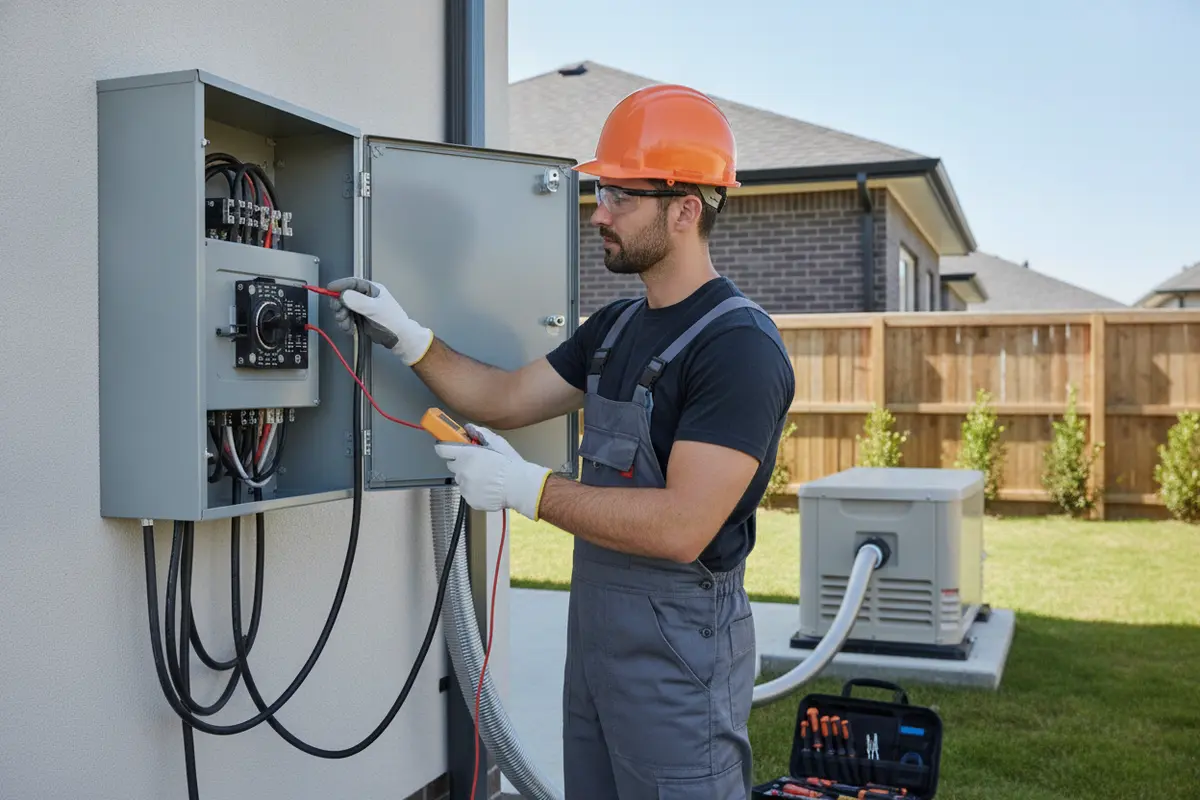
Owners can contribute to a safe plan without touching electrical equipment. Keep the proposed work area accessible, tell the electrician about any prior electrical changes, and share concerns about how the generator will be used. If an existing generator connection or transfer device is present, identify it during the assessment rather than assuming it is suitable for a new generator. Do not remove covers to provide a closer look. Clear photos of exterior labels, taken from a safe position, may help the electrician prepare, but they are not a substitute for an on-site review.
What permits and site details should Pasadena property owners expect?
Short answer: Permit and inspection needs depend on the scope, property, and authority having jurisdiction. Confirm requirements before work begins; do not assume a generator or transfer switch can be installed without review.
Before a site visit, gather the generator make and model if selected, the intended loads, photos of the electrical panel exterior and proposed equipment area, and any known plans for electrical upgrades. Share whether the property is a home, multi-unit building, or commercial site. Access, equipment clearances, fuel arrangements, noise considerations, and the route between generator and transfer equipment can affect the design.
The local permitting authority and utility may have requirements that apply to the specific project. The contractor should identify the applicable approvals, coordinate inspections where needed, and avoid energizing the system before required checks are complete. For a wider overview of service coverage, use the Southern California service-area page or learn about Expert Electric Group.
Property layout can shape the practical installation plan. The electrician may need to consider the path between the generator, transfer equipment, and service panel, as well as access for inspection and future maintenance. On a business site, loading areas, tenant spaces, operating hours, and shared electrical rooms may affect scheduling and access. In a residence, landscaping, gates, exterior walls, and the location of existing utilities can influence where equipment can be placed. These are site questions to review with the contractor, not a checklist for a property owner to resolve by moving or modifying electrical equipment.
Ask early whether the project involves any related electrical changes, such as panel work, circuit relocation, or modifications needed to fit the approved transfer equipment. A clear scope helps distinguish the basic transfer installation from work that may be required because of the existing service. If the authority requires plans or an inspection, understand who coordinates those steps and when the system may be operated. Requirements can vary, so avoid relying on a neighbor’s permit experience as a substitute for checking your project.
What happens during commissioning?
Short answer: Commissioning verifies that the installed equipment operates as intended, transfers safely, and returns to utility power correctly under the manufacturer’s procedures.
The installer checks terminations and equipment configuration, confirms control wiring and generator communication, and tests the transfer sequence. Testing may involve simulating loss and restoration of utility power using an approved method. The installer also confirms that the selected loads behave as expected and explains the system’s indicators, exercise schedule, and any routine checks the owner can perform.
- Ask for the equipment manuals and a clear operating overview.
- Confirm which circuits or loads are backed up and any limits on simultaneous use.
- Understand whom to contact if an alarm appears or the transfer sequence does not complete.
- Keep the inspection and commissioning records with the generator documentation.
Expert Electric Group is a Generac Authorized Dealer and Certified Installer, according to its company information. For a project that includes the generator itself, review whole-house generator installation considerations and generator sizing considerations for 400-amp service.
A useful handoff goes beyond showing that a test passed. Ask the installer to identify which indicator lights or display messages are normal, what a failed start or incomplete transfer might look like, and which troubleshooting steps are appropriate for an owner. The owner’s role should stay within the manual’s safe operating guidance; it should not involve bypassing safety devices or opening energized enclosures. Keep the final circuit list near the generator records, and update it if a later electrical project changes the backed-up loads.
For a property with staff or multiple occupants, decide who will receive the operating overview. A concise handoff can prevent confusion during an outage: identify the authorized contact, where documentation is stored, and what to do if the generator does not start as expected. For a home, make sure other household members know which circuits are covered and which appliances should not be added to the backed-up load during an outage without guidance. These small details make the installed system easier to use as designed.
What should you compare before choosing an installation plan?
Short answer: Compare the loads protected, equipment compatibility, permit and inspection scope, placement, and testing plan—not just the switch model.
Ask the electrician to explain whether the proposal covers a few critical circuits or a broader service transfer. Confirm that the generator can support the planned loads and that starting demand has been considered. Ask how utility isolation is achieved, what approvals are needed, how the installation will be tested, and what documentation you will receive. Cost depends on scope, materials, equipment, and site conditions, so a written, property-specific assessment is more useful than assuming one standard configuration fits every building.
For residential properties, the right plan may differ from a commercial facility with different operating needs and loads. Explore residential electrical service information or contact the company through its contact page to discuss the property.
When reviewing proposals, compare the same assumptions across each option. One estimate may include selected circuits and commissioning, while another may describe a wider service arrangement or leave related panel work unspecified. Ask each contractor to list the equipment, protected loads, exclusions, required approvals, and testing included. If the generator has not been purchased, confirm whether the proposed switch and controls are compatible with the candidate generator before making a decision. This makes a comparison more useful than matching totals without knowing what each includes.
Also ask what would trigger a change in scope once work begins. Existing wiring conditions, limited equipment space, or service details that were not visible during an initial discussion may affect the final plan. The contractor should explain how such conditions will be documented and reviewed with you before additional work proceeds. A clear communication process helps keep design decisions tied to safety and the actual property rather than assumptions made before inspection.
How do residential and commercial needs differ?
Short answer: The same basic transfer principles apply, but the load list, operating priorities, service configuration, and consequences of an outage can be very different.
A homeowner may prioritize a refrigerator, selected lights, communications equipment, and heating or cooling controls. A small business may instead identify security systems, point-of-sale equipment, network hardware, refrigeration, or process equipment. Those examples are prompts for planning, not a promise that every load can run together. The electrician must check each load’s electrical characteristics, starting demand, and whether the generator can support the combination.
For a business, consider which functions must continue immediately and which can pause until utility power returns. A transfer arrangement may serve only designated circuits, while other loads remain off generator power. Document who is authorized to operate equipment, what alarms mean, and where manuals and inspection records are kept. In a multi-unit property, planning also needs to account for shared loads, access, and clear communication with occupants or building staff.
When evaluating a plan, ask for a simple load list that identifies what is backed up and what is not. The list should use clear circuit or equipment labels rather than broad descriptions such as “essential power.” That makes later troubleshooting and operational decisions easier. If the property’s panel or service needs attention before generator work, the company’s panel upgrade service information can help you understand that related work.
For a household, agree on the priorities before the design is finalized. One person may want every convenience available, while another may prefer a smaller, simpler set of essential circuits. Discuss what matters during a brief outage versus an extended one, and whether any large appliance can be used only when other loads are off. The electrician can then evaluate those priorities against the generator’s output, the transfer equipment, and the service layout. Clear expectations also prevent the mistaken assumption that every receptacle or appliance will work simply because a generator is present.
For a commercial property, the planning conversation may include operational continuity, equipment restart order, and who has authority to respond to system indicators. Some equipment may require a specific sequence after power returns; the facility operator should identify those needs for the electrician. A property manager can also prepare a short outage plan for staff, including which loads are backed up and whom to notify if the generator does not operate normally. The installer still determines the electrical design, but accurate operational information helps it reflect the site’s actual priorities.
What should you prepare before the electrician’s visit?
Short answer: Bring the generator details, a priority-load list, and any known information about the electrical service so the assessment can focus on the actual property.
You do not need to open a panel or inspect wiring yourself. Instead, gather what is safely visible or already documented. Useful information includes the generator’s brand and model, any transfer equipment already installed, recent panel or service work, and the equipment you hope to keep running. If you have a panel directory, note whether it appears current; do not remove the panel cover to verify it.
- List outage priorities and distinguish must-run loads from nice-to-have loads.
- Note large motors or equipment with substantial starting demand, such as pumps or HVAC units.
- Share planned additions, including EV charging or future electrical upgrades.
- Provide photos of the panel exterior and proposed generator or switch location, taken without opening equipment.
- Identify access constraints, property rules, and any known permitting or utility discussions.
These details help the electrician ask better questions, but they do not replace measurements, load calculations, inspection, or equipment documentation. If you have not purchased a generator, it may be sensible to settle the intended backup loads and equipment compatibility first rather than choosing a model based on a neighbor’s system or a general rule of thumb.
To make the load list more useful, note how each item is used rather than only naming it. For example, state whether a pump must operate immediately, whether communications equipment needs continuous power, and whether an HVAC system is a priority or optional. If the panel directory is incomplete, say so; the electrician can verify circuits safely during the assessment. For a business, include equipment with restart requirements or an operational sequence that staff need to follow after an outage.
It also helps to gather questions in advance. Ask which information is still needed to choose equipment, whether the proposed installation depends on any panel changes, and what the next step is after the site assessment. If there are multiple decision-makers, invite them to review the priorities together before the visit. That can reduce late changes and help the electrician explain tradeoffs in terms that match the property’s actual use.
What questions should you ask before approving the work?
Short answer: Ask for a clear scope that explains equipment selection, protected loads, approvals, testing, and owner handoff.
A proposal should make it possible to understand what work is included and what depends on site conditions. Ask whether the design is for selected circuits or a broader service, which equipment models are proposed, and how generator controls coordinate with the switch. Confirm who will determine permit requirements and what inspections are anticipated. If the installation depends on panel modifications, clarify whether those are included or separately scoped.
Also ask how the system will be tested, what the owner should expect during a normal utility outage, and what steps should be taken if the generator starts but the property does not receive backup power. The answer should not invite an owner to handle live conductors or bypass protective equipment. Ask for manuals, commissioning notes, inspection documentation where applicable, and a final explanation of which loads are supported.
For a site-specific discussion, use the company’s recent project information as general context and reach out through its contact page. Project examples do not establish that a similar configuration will fit another property.
Before signing, make sure you understand the sequence from approval to operation. A practical scope should address equipment procurement, any permit or inspection coordination, installation, testing, and owner instruction. If the property has tenants or employees, ask whether access or a short outage during the work needs to be scheduled. Confirm how changes to the agreed work will be communicated, and keep a copy of the final scope with system records. These questions do not replace professional judgment; they help you understand the planned work and what decisions remain yours.
Call (747) 999-6090 to discuss your generator and transfer switch needs
Frequently asked questions
Can I install an automatic transfer switch myself?
No. Transfer switch installation involves service equipment and potentially hazardous conductors. Do not attempt energized work or make improvised generator connections; have a qualified electrician assess and complete the work.
Does an automatic transfer switch power the whole property?
Not necessarily. Some systems serve selected circuits, while others are designed for a broader service. The design depends on the switch, generator capacity, electrical service, and the loads the owner wants to support.
Will any generator work with any transfer switch?
No. Generator output, controls, switch ratings, wiring configuration, and manufacturer requirements must be compatible. Have the specific model information reviewed before equipment is purchased or connected.
Does a transfer switch need inspection?
Requirements vary with project scope and the authority having jurisdiction. Confirm permit and inspection requirements for the property before installation, and complete any required inspections before operating the system.
What is the next step?
For automatic transfer switch installation in Pasadena, prepare your generator details and priority-load list, then speak with an electrician about compatibility, safe isolation, permits, and testing before work begins.
