
A generator for custom homes Calabasas should be planned around the actual equipment and how your household uses it. HVAC zones, pool systems, EV charging and home automation can all affect which loads belong on backup. Call (747) 999-6090 to discuss a professional assessment with Expert Electric Group.
Call (747) 999-6090 to plan your generator assessment
What makes generator planning different for a custom home?
Short answer: A custom property may have more electrical systems, larger starting loads and more complex controls than a standard home, so the equipment list and backup priorities matter.
A floor plan alone does not reveal the right generator capacity. Two homes of similar size can have very different electrical demands. One may use a single cooling system and gas cooking. Another may have multiple cooling zones, electric cooking, a pool, a spa and a vehicle charger. The electrician needs to understand the equipment, circuits, fuel options and expected operation during an outage.
Begin with three categories: essential, useful and optional. Essential might mean refrigeration, selected lights, communications, security and one cooling zone. Useful could include additional HVAC zones or a garage door. Optional might include pool heating or EV charging. This ranking gives the design discussion a real operating scenario instead of an assumption that everything must run simultaneously. Explore the company’s electrical services for an overview of related work.
Which custom-home loads affect sizing most?
Short answer: High-demand equipment and motors can shape the plan, especially when several systems may operate at once.
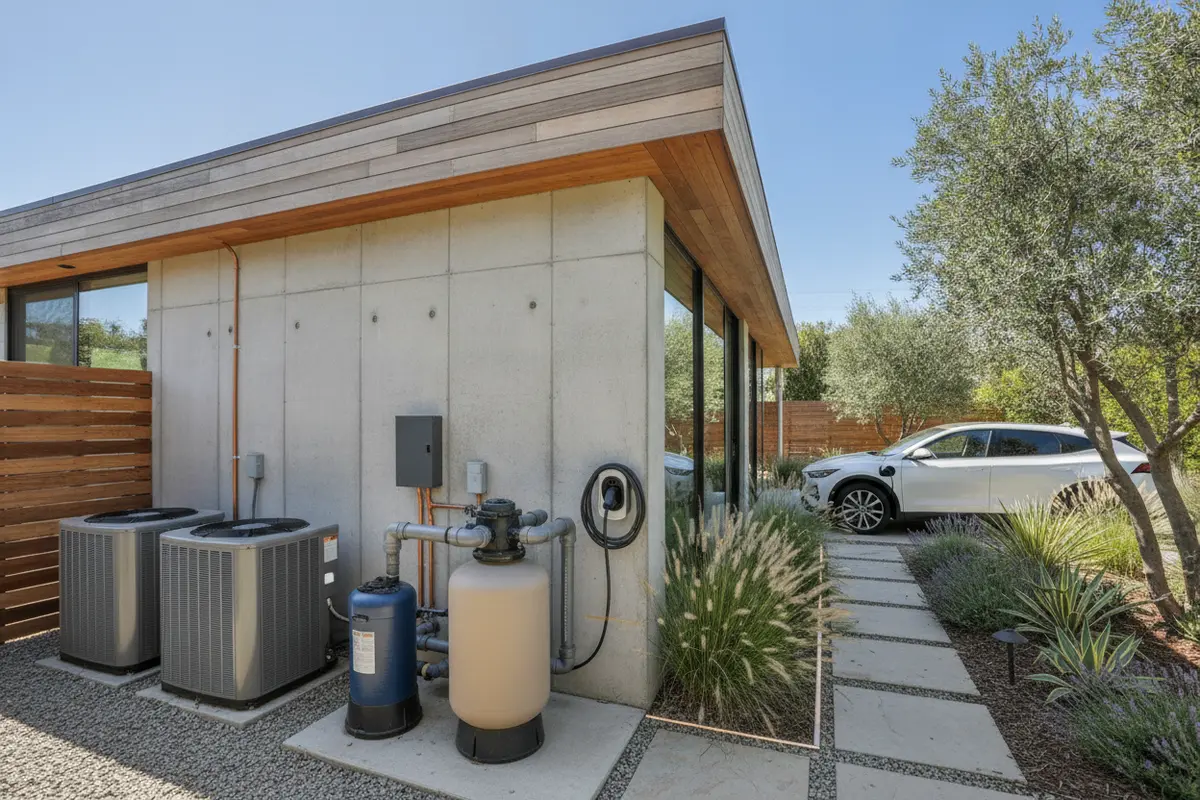
- HVAC: Multiple air-conditioning units, heat pumps and air handlers can have significant operating and startup demands. Identify the zones you expect to use, and ask how starting one compressor while other loads are operating affects the plan.
- Pool and spa equipment: Pumps, heaters and related equipment may be candidates for backup, but they compete with household needs. A pump may be a different priority from a heater; list them separately rather than treating the pool as one indivisible load.
- EV charging: A vehicle charger can be a substantial optional demand. Decide whether it should be excluded, limited or managed while generator power is in use. Do not assume it can charge at full output alongside all other loads.
- Automation and electronics: Controls, networking, security and communications may draw less power than large motors, but they can be important to comfort and function. Include the circuits and equipment needed to keep those systems operating.
- Kitchen and utility equipment: Electric ranges, ovens, dryers, water heating and refrigeration affect which combinations are practical. Clarify whether the household needs to use these appliances normally or can stagger them.
For a preliminary reference, review this guide to generator capacity and a home’s electrical service and this overview of minimum generator loads. Those topics help frame questions; they do not replace a calculation for the home’s actual equipment and circuits.
How can you turn a long equipment list into a backup plan?
Short answer: Decide what must operate together, what can be staged and what can be left off before choosing equipment.
Consider a hypothetical home with three cooling zones, a pool pump, a spa, an EV charger, refrigeration and a control system. A first-pass plan could keep refrigeration, security, network equipment, selected lighting and one cooling zone available. The pool pump might run only when the HVAC demand is low; the spa heater and EV charger could remain off during an outage. This is not a capacity recommendation. It is a clear scenario the electrician can evaluate against nameplate information, startup characteristics and the proposed equipment.
Write the scenario in ordinary household language. For example: “Keep the primary living area cool, preserve refrigeration and communications, and allow the pool pump only when the vehicle is not charging.” Then ask the electrician to translate that into circuits, controls and operating limits. If a household member needs a particular system for health, work or accessibility, identify that requirement early. The design should reflect actual priorities, not just a generic list of appliances.
Also discuss who will manage optional loads. Is the plan based on manual choices, such as turning off a charger, or equipment that controls loads automatically? Ask what happens if two high-demand systems try to start together and whether the system provides a clear indication when a load must be paused. The answer affects both comfort and ease of use.
Should you back up the whole home or selected circuits?
Short answer: Whole-home backup aims to support more of the property, while selective-load planning directs available capacity to chosen circuits and uses.
Neither approach is automatically right for every custom home. Broader backup can offer convenience, but it requires evaluating simultaneous demand and the electrical arrangement. Selective-load planning can focus on essentials and leave high-demand or nonessential equipment outside the backed-up group. Some plans use staged operation so selected equipment is available only when other loads are inactive.
| Planning approach | What it prioritizes | Questions to resolve |
|---|---|---|
| Broader home backup | More circuits and everyday convenience | Can the equipment support expected combinations? Are service or panel changes needed? |
| Essential-circuit backup | Refrigeration, lighting, communications and selected HVAC | Which circuits are essential, and what should remain off? |
| Managed or staged loads | Essentials plus selected high-demand equipment by schedule or operating rules | How are loads controlled, and who will operate them? |
These are planning approaches, not substitutes for equipment specifications or a load calculation. Ask the electrician to show which loads are included, which are excluded and what happens when multiple large loads request power at once. A useful proposal should describe the expected operating pattern in plain language, not just state a generator rating.
For another load-planning reference, see how generator load is checked. The calculations and final equipment selection should be based on the particular installation.
Call (747) 999-6090 to review your backup priorities
How do panel capacity and transfer equipment affect the project?
Short answer: The generator, service equipment, panels and transfer arrangement must work together, and existing conditions can change project scope.
A custom home may have a large service, multiple panels or subpanels and dedicated circuits for mechanical equipment. The assessment should identify service rating, panel condition, available spaces, circuit layout and the loads proposed for backup. A panel rating alone does not tell you how much generator capacity is appropriate: the load plan and equipment ratings matter too.
If the existing electrical system needs changes, a panel upgrade or related work may enter the project scope. Ask what issue the proposed change addresses and whether it is required for the selected backup design. For background, see the guide to larger residential electrical panels.
Transfer equipment manages the connection between utility and generator power. It must fit the service arrangement and backup strategy. Review whole-house generator installation considerations and the company’s home generator installation and maintenance information before the assessment so you can prepare questions. Do not assume a large panel means a large generator is automatically needed, or that every circuit can be supported simply because the generator can be connected.
What site and approval details should Calabasas homeowners consider?
Short answer: The location, access, clearances, fuel arrangement, noise considerations and required approvals should be reviewed for the specific property.
Custom-home sites can have landscaped slopes, retaining walls, narrow side yards or outdoor living areas that constrain equipment placement and installation access. The proposed location should be considered in relation to the home, openings, service access and the way the family uses nearby spaces. Fuel availability and the connection method also need confirmation. Do not select a site solely because it appears convenient on a property sketch.
Ask the installer which permits and inspections apply, who coordinates them and what information is needed from you. The authority having jurisdiction determines applicable requirements, so general advice is not a final approval. Ask how the plan accounts for the local site and what could change after review. For company coverage information, see the Southern California service areas page.
Keep a written record of the agreed location and scope. If landscaping, hardscape or access preparation is expected, clarify who handles it and when. This prevents an assumption in the early planning stage from becoming a surprise during installation.
How should you compare generator proposals?
Short answer: Compare documented scope and promised loads, not just an advertised generator capacity.
- Confirm backed-up equipment. Request a clear list of circuits and appliances included, excluded or subject to operating limits.
- Review load assumptions. Ask how HVAC startup, pool equipment, cooking and EV charging were considered and which combinations can run together.
- Check the electrical scope. Understand whether the proposal includes transfer equipment, panel work, wiring, site preparation, startup and inspection coordination.
- Clarify control and operation. Find out how loads are managed and what household members should do during an outage.
- Discuss testing and upkeep. Ask what checks the manufacturer recommends, how commissioning is documented and what maintenance the owner should plan.
- Compare assumptions in writing. A proposal should identify site conditions or choices that may alter the scope. Cost depends on scope and materials.
Useful technical questions include: What happens if two HVAC systems start together? Is the EV charger included in the backup plan? Can a pool pump operate while cooking equipment is in use? Which circuits are intentionally excluded? What changes, if any, are proposed for the panel? Ask for explanations rather than relying on a single capacity number.
For additional context on a specific system, read the guide to breaker sizing for a 22 kW Generac. Verify all model and installation details with the electrician for the equipment being considered.
What should you prepare before an assessment?
Short answer: Gather equipment details, rank backup needs and describe how you expect the home to operate during an outage.
- List HVAC systems, pool and spa equipment, EV chargers, cooking appliances, water heating and other major loads.
- Mark each item essential, useful or optional, and note which systems you expect to run at the same time.
- Collect panel schedules, service information and equipment model numbers if readily available.
- Describe planned additions, such as a charger, pool equipment or home expansion, so the plan considers future needs.
- Identify possible equipment locations and any access, noise, landscaping or outdoor-use concerns.
- Note any specific household need that makes a load more important than its electrical demand might suggest.
Photographs of electrical panels and outdoor equipment can help introduce the discussion, but they do not replace an in-person review. A useful preparation exercise is to describe a normal outage day: which rooms are occupied, which cooling zones matter, what appliances are likely to run and which optional systems can wait. That example helps the electrician check whether the proposed strategy is workable for your household.
For more installation context, review generator installation and maintenance information using the available installation guide at this page. Expert Electric Group provides electrical services across Southern California, including generator installation and panel work.
Call (747) 999-6090 to request a professional assessment
Frequently asked questions
Can a generator run central air conditioning in a custom home?
It may be possible, but the specific HVAC equipment, startup demand and other loads operating at the same time must be evaluated. Ask which cooling zones and operating combinations the proposed plan supports.
Should an EV charger be included in generator backup?
That depends on your priorities, charger specifications and available capacity. Some homeowners treat charging as a lower priority during an outage or plan to pause it while essential loads run. Make the choice explicit in the backed-up load list.
Can pool equipment run during an outage?
It may be included if the system is designed for it, but pumps and heaters should be weighed against essential household loads. Identify separately which pool components you want available and how often you expect to use them.
Will I need a panel upgrade?
Not necessarily. The existing service and panels need to be inspected to determine whether they can accommodate the proposed transfer equipment and circuits. If changes are required, ask what condition they address and have them documented in the scope.
Planning around actual equipment, household priorities and site conditions helps turn a generator idea into a clear, reviewable plan. A professional assessment can help determine what a system for your Calabasas home can support.
California’s hazardous-waste generator guidance concerns people or sites that produce regulated hazardous waste, not residential standby generator sizing, so it does not establish a capacity or installation rule for this project. See the California Department of Toxic Substances Control’s generator guidance for that distinct meaning of the term.
