
Smart home EV charger installation gives Southern California homeowners more than a faster way to charge. A properly planned Level 2 setup can coordinate charging schedules, available circuit capacity, solar or battery use, and the physical layout of your garage. The right design starts with the home’s electrical system, not an app or a product box.
Call Expert Electric Group at (747) 999-6090 to plan your smart EV charger installation.
What makes a home EV charger smart?
A smart home EV charger uses connected controls to manage scheduling, monitoring, charging current, and sometimes coordination with solar, batteries, or household energy demand. The useful feature set depends on the charger, vehicle, electrical design, and internet or energy-system connections available at the home.
For a homeowner, the useful question is not whether a charger has the word smart on its box. Ask whether its controls solve a real household need without creating a new electrical or connectivity problem.
- Scheduling: Set charging for a preferred time window instead of starting at plug-in.
- Remote monitoring: Check charging status, energy use, and alerts through an approved app.
- Adjustable current: Configure the charger to match the circuit and the home’s approved design.
- Load coordination: Pause or reduce charging when other large loads are using the panel.
- Energy integration: Some systems can coordinate EV charging with solar production or battery storage.
- Access controls: Passwords, user permissions, or vehicle recognition can help prevent unwanted use.
The U.S. Department of Energy Alternative Fuels Data Center explains home charging options, including the difference between Level 1 and Level 2 equipment, the importance of code-compliant installation, and the role of a qualified electrician. Those fundamentals still apply when the charger adds app controls or energy-management features.
How should you plan circuit capacity and load management?
A smart charger can manage charging behavior, but it cannot make an undersized circuit safe. Capacity planning checks the panel, feeder, breaker, conductors, disconnects, and charger settings against the home’s expected load. A licensed electrician should complete this evaluation before equipment is selected or configured.
Most residential Level 2 chargers use a 240-volt circuit. The required circuit size depends on the charger’s approved settings, the installation method, the vehicle’s charging capability, and the rest of the home’s electrical demand. EV charging is treated as a continuous load, so the assessment must account for sustained operation rather than a brief appliance surge.
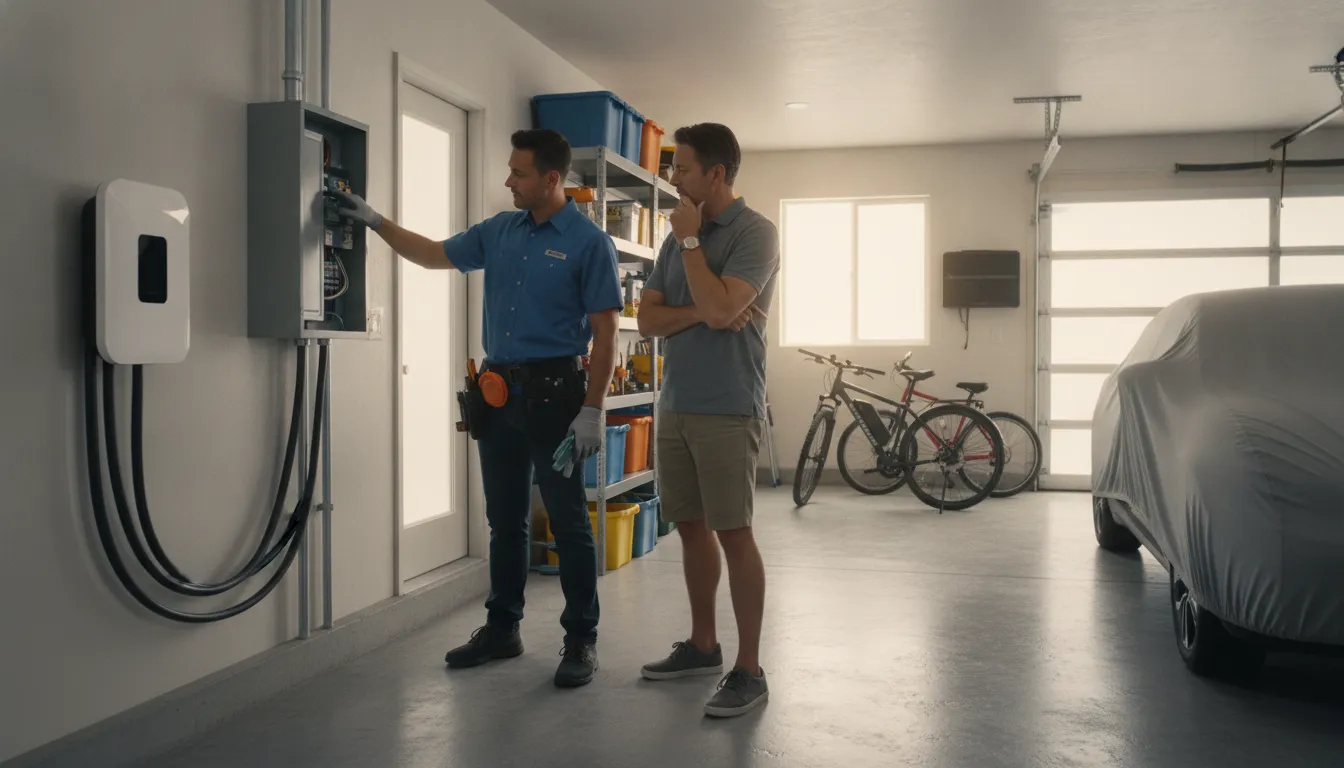
Load management may be useful when a panel has limited spare capacity. A managed system can reduce or pause vehicle charging while another major load is operating. It does not remove the need for a load calculation, a suitable circuit, correct overcurrent protection, or a panel that is in safe condition. Review the dedicated guide to EV charger load management for limited home panels when this is the central concern.
Older homes may need additional review for panel condition, grounding, conductor sizing, or circuit organization. If the proposed charger cannot fit safely within the existing service, the options may include a lower charging setting, a managed charging design, a new subpanel, or an electrical panel upgrade. The correct option depends on the site findings, not on a universal amp number.
Which smart Level 2 charger features matter most?
The best smart Level 2 charger matches the vehicle connector, electrical design, mounting location, connectivity, and daily charging routine. Prioritize dependable controls, compatible energy integrations, and documented current settings over a long list of app features that do not solve a household need.
| Feature to compare | Why it matters in a home setup | Planning question |
|---|---|---|
| Connector compatibility | J1772 and NACS equipment serve different vehicle and adapter needs. | What connector does your current vehicle use, and could a future vehicle differ? |
| Charging current control | Adjustable settings can align the charger with the approved circuit design. | Can the electrician document the final setting and breaker relationship? |
| Dynamic load management | Charging can respond to other large household loads when the system supports it. | Where will the monitoring equipment measure the home’s load? |
| Energy integration | Solar or battery coordination may improve how charging fits into the home’s energy plan. | Does the charger communicate with the existing energy system? |
| Connectivity | Wi-Fi, Ethernet, Bluetooth, or cellular options affect commissioning and reliability. | Will the charger have a stable signal at the proposed mounting point? |
| Weather protection | Outdoor equipment needs a suitable enclosure and installation location. | Is the model rated for the actual exposure at your home? |
Product claims should be checked against the manufacturer’s current documentation. For example, Enphase describes its IQ EV Charger 2 as a smart Level 2 product that can work with an energy-management ecosystem, while other manufacturers use different controls and compatibility requirements. Do not assume that two chargers share the same app, wiring method, connector behavior, or load-management capability.
Also consider what happens if internet service is interrupted. Ask whether the charger can continue a safe scheduled or default charge, how alerts are delivered, and which settings remain available locally. A professional installer can help separate a useful feature from a feature that adds unnecessary complexity.
Where should a smart EV charger be placed?
Place a smart EV charger where the cable reaches the vehicle safely, the circuit route is practical, the equipment remains accessible, and required connectivity is reliable. Outdoor exposure, detached garages, long driveways, and future maintenance can all change the right mounting location and installation scope.
- Choose a firm wall or approved mounting surface with enough clearance for the equipment.
- Keep the cable path short and protected, without routing across doors, drive paths, or walking areas.
- Confirm that the vehicle can park in the intended position without stretching the cable.
- Check Wi-Fi or other required connectivity at the proposed charger location.
- For an outdoor installation, select equipment rated for the location and protect the connection from weather as required.
- Leave room for an electrician to inspect the charger, disconnect, conduit, and related equipment later.
Garages often make placement simpler, but they are not automatically ideal. A detached garage, long driveway, or exterior wall may change the trenching, conduit, disconnect, and inspection requirements. Discuss the complete route during the assessment instead of choosing a charger based only on the distance to the parking space.
Do you need a permit for EV charger installation in Southern California?
Many Southern California EV charger projects require a local permit and inspection when they add or modify a 240-volt circuit, panel equipment, conduit, or service capacity. Requirements vary by city, county, property, and scope, so confirm the permit path with the electrical contractor and local authority.
California’s streamlined EV charging guidance is intended to make eligible permitting more predictable, but it does not eliminate health and safety review. The California Governor’s Office of Business and Economic Development outlines EV charging permit streamlining and the requirements jurisdictions use for review. The local agency still controls the permit submission and inspection process for the property.
A complete permit conversation should cover the charger model, circuit and breaker design, load calculation, mounting location, wiring route, disconnect requirements, panel changes, and any applicable garage or exterior work. If a panel upgrade or trenching is needed, that additional scope may change the documents and inspections. Avoid relying on a generic internet checklist that does not match your jurisdiction.
What does the smart charger installation process look like?
A safe smart home EV charger installation follows a clear sequence: assess the home, define the charging need, design the circuit, confirm permits, install the equipment, then inspect and commission the system. Starting with the electrical assessment helps prevent incompatible equipment and capacity problems.
- Review the home: The electrician checks the service rating, panel condition, available capacity, grounding, wiring routes, and charger location.
- Define the charging need: Discuss the vehicle connector, driving routine, desired charging window, solar or battery system, and connectivity needs.
- Design the circuit: The electrician selects the circuit, breaker, conductors, equipment settings, and any load-management components that fit the assessment.
- Confirm permits: The contractor identifies the local permit path and prepares the information needed for review.
- Install the equipment: The work includes mounting, wiring, protection, labeling, and any approved panel, conduit, or disconnect changes.
- Inspect and commission: After required inspection, the installer tests charging, configures the app or energy controls, and reviews safe operation with the homeowner.
Commissioning is more than downloading an app. It should confirm that the charger starts and stops as expected, the selected current matches the approved design, load-management behavior is understood, and the homeowner knows how to respond to an alert or fault. Keep the equipment documentation and inspection records with the home’s electrical information.
Expert Electric Group provides residential EV charger installation across Southern California, including planning for Tesla, ChargePoint, FranklinWH, and other compatible equipment. Equipment availability and compatibility should be confirmed for the specific vehicle and site.
How can you prepare for an electrician’s assessment?
Prepare the vehicle details, connector type, parking location, daily driving needs, electrical-panel information, and any solar, battery, or energy-management details before the assessment. These facts help the electrician match the smart charger, circuit, controls, placement, and permit scope to the actual home.
- Take clear photos of the main electrical panel without removing the cover.
- Note the panel’s labeled service rating if it is visible.
- Identify large electrical loads such as air conditioning, pool equipment, electric ranges, heat pumps, or spas.
- Mark where the vehicle normally parks and how far the cable must reach.
- Share any concerns about Wi-Fi coverage, outdoor exposure, or future vehicle changes.
- Ask what permits, inspections, equipment settings, and records are included in the proposed scope.
Pricing depends on scope, materials, equipment, access, and the condition of the existing electrical system. A written assessment is more useful than a generic online figure. If you are ready to discuss your home, use the home EV charger quote request or call the team.
Frequently Asked Questions
What is a smart home EV charger?
A smart home EV charger is a connected Level 2 charging system with controls such as scheduling, remote monitoring, adjustable current, energy tracking, or coordination with solar, batteries, or other household loads. Features vary by manufacturer and model.
Can a smart charger work with an older electrical panel?
It may, but the answer requires a load calculation and inspection of the panel, wiring, grounding, and available capacity. A managed charging design, a lower approved setting, a new circuit, or a panel upgrade may be appropriate depending on the home’s condition.
Is load management the same as a panel upgrade?
No. Load management changes when or how strongly the vehicle charges in response to household demand. A panel upgrade changes the electrical service or distribution equipment. An electrician can determine which approach fits the home’s existing capacity and future needs.
Can I install a smart EV charger myself?
Do not work inside an energized panel or improvise a high-power EV circuit. A licensed electrician should evaluate the electrical system, install the circuit and protective equipment, complete required permitting, and verify safe operation.
How long does a smart EV charger installation take?
The timeline depends on the circuit route, panel condition, equipment, permit process, inspection availability, and whether an upgrade or trenching is required. An electrician can provide a realistic schedule after reviewing the property.
What should I do if the charger loses internet access?
Check the charger’s documented offline behavior and do not change electrical settings without professional guidance. Many systems retain limited local operation, but the exact behavior depends on the model, configuration, and energy-management equipment.
